Norridge, IL · Garage Door Service
When a Spring Goes in Cold Weather in Norridge
Norridge homes built 1938-1994 run original torsion hardware that cold weather hits hard. Norridge Garage Door Pros explains what breaks, why, and what to check first.
- Repairs & new doors
- Springs & openers
- Serving 4 nearby communities
What Is Going On
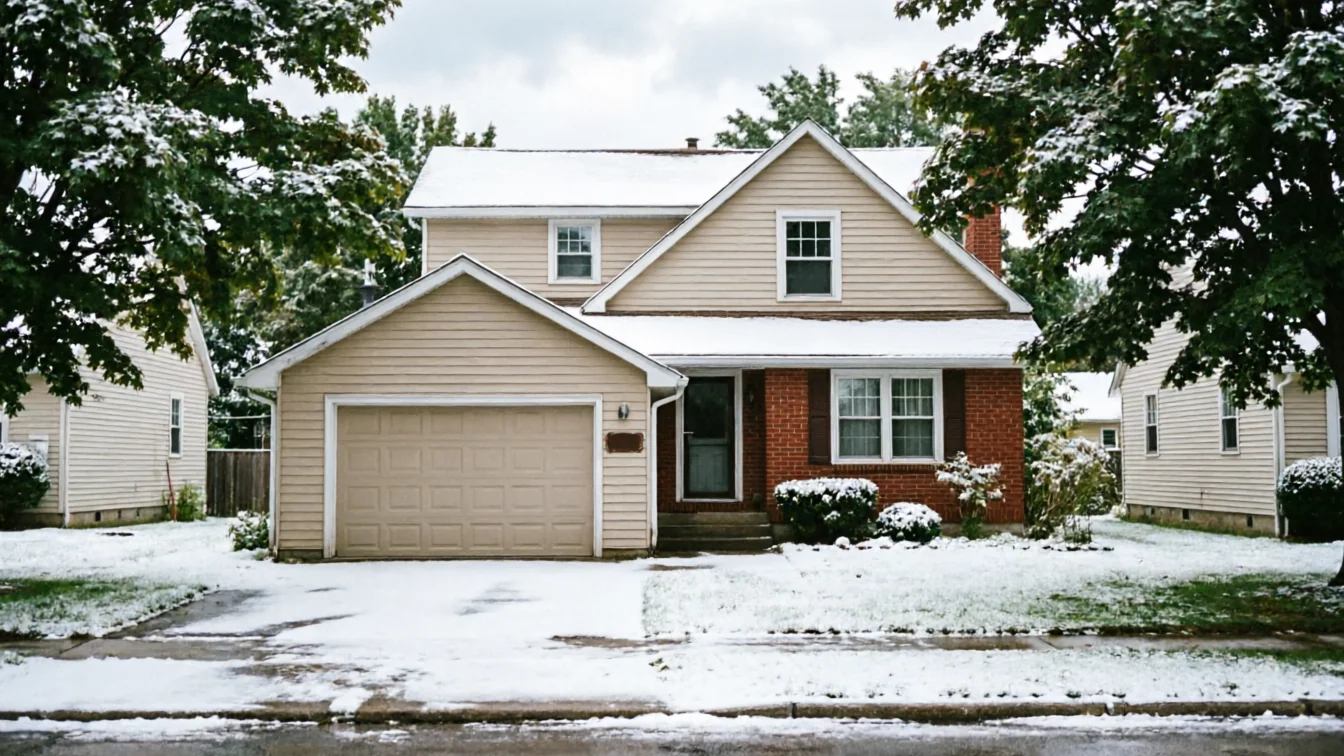
Most houses in Norridge went up between 1938 and 1994, with the bulk of the stock dating to the 1960s and 70s. That matters because a torsion spring has a working life measured in cycles, not years, and a spring installed on a house built in 1967 has had five or six decades to do its job. Steel fatigues. It doesn't fail gradually - it fails on one cycle, usually the one where the metal is coldest and least flexible.
When a spring goes in cold weather, it's rarely a surprise to the spring. The wear was already there. What changes with temperature is how the steel behaves at the moment of failure: cold steel is more brittle, so a spring that might have limped along another week in July can snap clean in January. On an older Norridge garage, especially one still running its original hardware, that's often the first sign anything was wrong at all.
The door itself usually isn't the problem. It's the spring, the cable it's wound around, or the bearing plate it sits on - all original-era parts on a lot of these houses. If your door suddenly won't lift, or lifts crooked, or makes a bang followed by silence, that's consistent with a spring letting go, not a motor issue.
What You Pay
We don't have a flat number to hand you here, and we'd rather tell you that than make one up. What drives the cost on a Norridge job is usually the spring size (tied to door weight), whether it's a single spring or a pair, and whether the drums, cables, or bearing plates also need replacing because they're the same age as the spring that just broke.
On a house from the 1960s or 70s stock that's common across this area, it's not unusual for one failed part to reveal a second one close behind - a worn cable that was riding on borrowed time, or a bearing plate that's been grinding quietly for years. We'll tell you straight if that's what we're looking at rather than just swapping the one part you called about.
What we can tell you: a torsion spring job is a same-day fix for most houses in this area. Full door replacement is a different conversation, and one we'd only recommend if the door itself - panels, track, the opener mount - is failing alongside the spring, not just the spring on its own.
What Local Conditions Do
Norridge sits in a cold, moderate climate band, which means winters cold enough that steel springs contract and stiffen, but not so extreme that you're dealing with the kind of sustained deep-freeze that some northern service areas see. That's the range where a weak spring is most likely to fail without much warning - cold enough to stress the metal, common enough that it happens every winter to somebody.
The area immediately around Norridge backs this up with the geography: O'Hare is a mile northwest, Norwood Park and Schiller Park are both within two miles, and the broader belt of close-in suburbs - Harwood Heights, Dunning, Portage Park, River Grove - all sit on the same general housing timeline and the same weather. None of that changes the mechanics of a spring failing, but it does mean the pattern we see on a Norridge call is consistent with what we'd expect on a house of the same age two or three miles over.
Houses built before double-insulated doors were standard also tend to have garages that track outdoor temperature more closely than a modern insulated bay would. That's not dramatic, but it's one more reason an old spring on an old door feels the cold first.
Checking It Yourself
Before you call anyone, look at the spring itself - it's the coiled bar above the door, mounted on a shaft. A separated spring shows a visible gap in the coil, sometimes with the two halves twisted apart. If you see that, stop. Don't try to open the door manually and don't let anyone stand under it. A wound torsion spring holds a lot of stored force, and on a house with 1960s-era hardware, the anchor bolts holding that assembly in place are also original and not something to trust under sudden load.
If the spring looks intact but the door won't lift, check whether it's off-track instead - a bent track or a roller that's jumped the rail will bind the door without a spring failure at all. That's a different repair and often a cheaper one.
One honest limit here: we can talk you through what you're looking at over the phone, but we can't diagnose a spring from a description alone with full certainty - a cable that's frayed but not snapped can look, from across the garage, a lot like a spring that's fine. If the door won't move and you're not sure why, that's a call, not a guess.
Frequently asked questions
Why did my spring break in the middle of winter with no warning?
A torsion spring doesn't wear out gradually - it fails on a single cycle, usually once metal fatigue has already set in. Cold steel is more brittle, so a spring that was already near the end of its life is more likely to snap in a cold stretch than a mild one. On a house built in the 1960s or 70s with original hardware, that spring has had decades of cycles to reach that point.
Is it safe to open my garage door by hand if the spring broke?
No. A broken spring means the door has no counterbalance, and on older Norridge hardware the mounting points weren't built to hold the door's full weight under hand force. Leave the door where it is and keep the area clear until the spring is replaced.
Do I need a new door or just a new spring?
Usually just the spring, and on most houses in this area it's a same-day repair. Replacement makes sense when the panels, track, or opener mount are also failing - not because the spring broke on its own.
How do I know if it's the spring or something else, like the track?
Look at the spring above the door - a clean gap in the coil means it's gone. If the spring looks intact but the door still won't move smoothly, check the track and rollers for a bend or a jumped rail, which is a separate and often simpler fix.
Related garage door services in Norridge
More garage door guides
Book garage door service in Norridge
Call now or request a quote - tell us what the door is doing and where you are.